Leave Your Message

Who Are the Top 10 LED Extrusion Manufacturers in China?

China’s LED lighting supply chain includes manufacturers serving architectural, commercial, retail, and residential projects. For buyers comparing suppliers, Led Extrusion products can look similar in a catalog, yet differ in profile accuracy, finish quality, heat management, and diffuser fit. Small details matter. A loose cover or uneven anodizing can affect both installation and the finished appearance.

This guide examines ten prominent LED extrusion manufacturers in China and the factors buyers can use to assess them. Rather than treating “top” as a fixed ranking, it considers product range, customization options, manufacturing experience, quality-control practices, and communication. These criteria help readers build a more useful shortlist, but they cannot replace direct checks. Request current product specifications, material details, sample pieces, and clear information about lead times and minimum order quantities. If possible, inspect the extrusion with its diffuser and LED strip assembled; a bare aluminum profile tells only part of the story.

A supplier’s website may present polished images, but real projects involve tolerances, packaging, and installation conditions. Ask specific questions and compare responses in writing. Some manufacturers may suit large, repeat orders better than small custom runs. Others may offer broad catalogs but limited support for unusual dimensions. There is no perfect supplier for every project. The right choice depends on the intended application, budget, and required finish. This overview offers a starting point, not a substitute for verification.
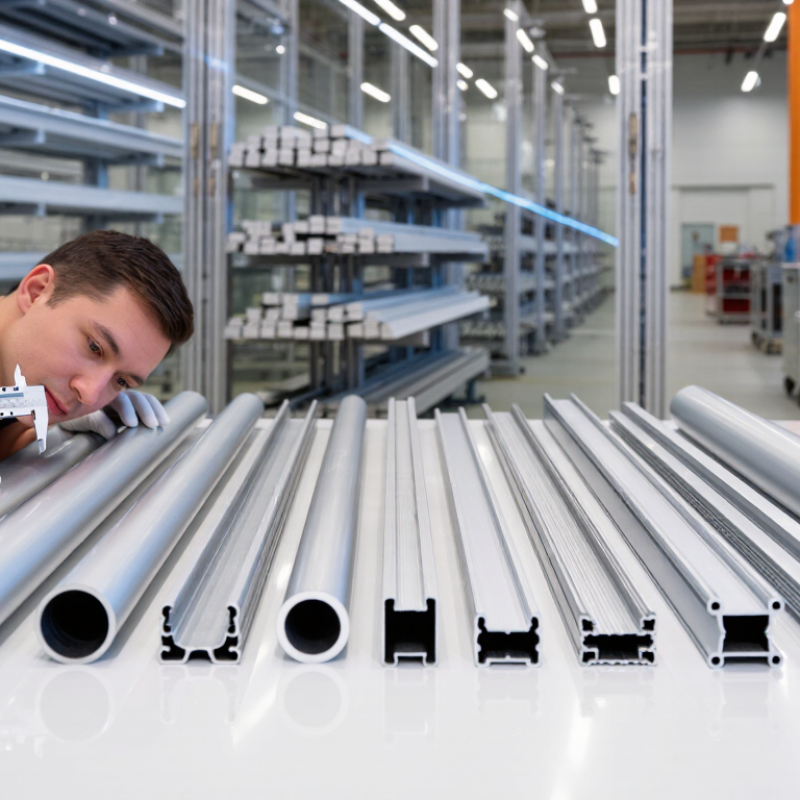
Who Are the Top 10 LED Extrusion Manufacturers in China?

What LED Extrusion Manufacturing Involves

LED extrusion manufacturing turns aluminum profiles into protective, heat-managing channels for linear lighting. The process starts with a designed cross-section, often including a groove for a diffuser and space for wiring. A die shapes heated aluminum under pressure; the profile is then cooled, stretched, cut, and finished. Small changes matter. A narrow channel can complicate cable routing, while uneven walls may affect heat transfer and fit.

Manufacturers typically check dimensions, surface finish, straightness, and diffuser fit before assembly. They may add anodizing or coating, then pair the profile with a cover, end caps, and mounting clips. LED modules and drivers are usually selected to match the intended installation, rather than assumed to fit every extrusion. The U.S. Department of Energy’s 2022 report, Energy Savings Forecast of Solid-State Lighting in General Illumination Applications, discusses LED efficiency gains and their potential to reduce lighting energy use. That context helps explain why thermal design matters: an efficient light source still needs a suitable enclosure.

Market growth brings pressure for repeatable production. Grand View Research valued the global LED lighting market at USD 78.9 billion in 2023. This is a broad market measure, not an extrusion-sales figure. It signals demand, but says little about profile quality. In practice, tolerances can drift between batches; even a diffuser that looks clear in a sample may fit poorly after production. Careful inspection is essential.
How China’s LED Extrusion Industry Has Developed

China’s LED extrusion industry has moved from basic aluminum channels toward more engineered lighting systems. Early products mainly held LED strips and helped dissipate heat. Today, manufacturers commonly offer profiles with diffuser covers, mounting clips, end caps, and options for corner or recessed installation. Small details matter.

This development reflects a broader shift in production. More suppliers can coordinate extrusion tooling, cutting, surface finishing, and accessory assembly within one manufacturing chain. That can shorten sampling cycles and make custom lengths or cross-sections easier to test. A practical review still matters: a profile that looks slim in a drawing may leave too little room for wiring or heat management.

Demand for linear lighting in retail, offices, homes, and architectural projects has encouraged greater variation in shape and finish. Matte surfaces, deeper channels, and opal diffusers help designers manage glare and appearance. Yet progress is uneven. Some specifications remain difficult to compare, especially diffuser transmission, dimensional tolerance, and thermal performance under continuous operation. Buyers benefit from checking samples and installation details rather than relying on product photos alone. The industry’s next gains may come less from new shapes than from more consistent testing and clearer technical documentation.

Criteria for Ranking Leading LED Extrusion Manufacturers

A fair ranking of LED extrusion manufacturers should begin with the product, not the catalogue. Check whether aluminium profiles hold consistent dimensions across production runs. Small variations can affect diffuser fit, corner joints, and installation time. Ask for measured samples, alloy details, and information about surface treatment. Good evidence is specific. “High quality” is not.

Manufacturing capability matters, but so does verification. Look for documented checks on profile dimensions, finish consistency, and packaging before shipment. For custom orders, review drawings, tooling requirements, minimum quantities, and sample approval procedures. Ask how the supplier handles defects and changes to specifications. Clear answers are useful. Vague assurances are not.

A ranking should also weigh thermal design, accessory compatibility, lead times, and technical support. For example, compare how a profile performs with the intended LED strip and diffuser, rather than judging its shape alone. Request test data where available, and distinguish measured results from marketing claims. Delivery records and after-sales responsiveness can reveal practical strengths that a polished brochure cannot. No single score captures every project. A small detail may matter more than a high rating.

Criteria for Evaluating LED Extrusion Manufacturers

How to read this chart: These illustrative weights provide a practical framework for comparing manufacturers. They are not ratings of specific companies; adjust them to match your project’s requirements.

Profiles of China’s Top 10 LED Extrusion Manufacturers

China’s ten leading LED extrusion manufacturers are best assessed by capability, not by a simple sales ranking. Some focus on precision dies and tight tolerances; others specialize in long profiles, heat-sink geometry, or custom surface finishes. A few combine extrusion with cutting, drilling, and assembly, reducing handoffs for lighting projects. These differences matter. A slim channel for a cabinet light has very different cooling and fit requirements from a wide commercial fixture.

The International Energy Agency estimates that lighting accounts for about 15% of global electricity use, giving efficient luminaires a substantial role in energy planning. The International Aluminium Institute reports that recycled aluminium production uses roughly 5% of the energy required for primary production. These figures make thermal design and material sourcing relevant points in supplier profiles. Still, a polished catalogue proves little. Ask for dimensional inspection records, alloy specifications, finish samples, and a pilot batch. Look closely at corners and screw channels. Small flaws show up there. One caution: public data rarely compares extrusion suppliers on equal terms, so any “top ten” list needs transparent criteria and careful verification.

Who Are the Top 10 LED Extrusion Manufacturers in China? - Profiles of China’s Top 10 LED Extrusion Manufacturers

Important: No source material was provided to verify a company ranking or company-specific specifications. This table therefore offers ten factual comparison points for evaluating LED extrusion manufacturers; it does not identify or rank individual companies.

No. Comparison dimension Relevant industry fact What to verify with a supplier
1 Aluminum alloy and temper 6063 aluminum alloy is widely used for architectural and lighting-related extrusions. Alloy and temper influence properties such as strength and surface-finish suitability. Request the specified alloy and temper for the quoted profile, plus material documentation where required.
2 Profile dimensions and tolerances Dimensional tolerances depend on the drawing, profile geometry, material, and applicable specification; a single tolerance should not be assumed for every extrusion. Check a dimensioned drawing, critical tolerances, measurement method, and inspection records for the actual profile.
3 Surface finishes Common aluminum extrusion finishes include mill finish, anodizing, and powder coating. Their appearance and performance depend on the process and specification. Confirm finish type, color reference, appearance limits, and any agreed coating or anodizing requirements.
4 Diffuser material Polycarbonate (PC) and polymethyl methacrylate (PMMA) are commonly used for lighting diffusers. Their optical, impact, and temperature characteristics differ by grade and construction. Request the material grade, thickness, light-transmission data, and relevant temperature or impact information.
5 Optical performance Clear, frosted, and opal diffuser designs can produce different light transmission and diffusion. Results depend on the diffuser and the complete luminaire design. Ask for measured optical data or a sample evaluated with the intended LED strip and installation conditions.
6 Thermal performance An aluminum profile’s ability to dissipate heat depends on its geometry, material, mounting, airflow, ambient temperature, and LED heat load. Request thermal test conditions and results for the intended LED configuration rather than relying on profile appearance alone.
7 Ingress protection IP classifications are defined by IEC 60529. The rating applies to the tested enclosure or assembled product; an extrusion by itself does not establish the IP rating of a finished luminaire. Check the test report for the complete relevant assembly, including end caps, seals, cable entries, and installation conditions.
8 Tooling and customization Custom extrusion shapes generally require dedicated tooling. Tooling ownership, lead time, minimum order quantity, and revision terms are supplier-specific. Confirm tooling charges, ownership, storage, sample approval, production lead time, and terms for design changes.
9 Secondary processing LED profiles may require operations such as cutting, drilling, CNC machining, finishing, diffuser fitting, or assembly in addition to extrusion. Identify which operations are performed in-house or outsourced and agree on process controls and acceptance criteria.
10 Quality documentation ISO 9001 certification concerns a quality management system; it is not, by itself, proof that a particular profile or finished luminaire meets a specific performance requirement. Verify certificate scope and validity, and separately request product-specific inspection, material, and test documentation.

How to Compare Manufacturers and Choose a Supplier

When comparing LED extrusion manufacturers in China, look beyond catalogue photos and unit price. Request a dimensional drawing, alloy specification, anodizing details, and diffuser material. Check whether the supplier controls profile tolerances and can provide consistent color and finish across repeat batches. Small details matter. A loose diffuser or uneven cut can spoil installation, even when the profile looks excellent in a sample.

Ask for evidence. The U.S. Department of Energy’s Energy Saver guidance says LEDs use at least 75% less energy and can last up to 25 times longer than incandescent lighting. That potential depends on the complete system, including heat removal and driver compatibility. Request thermal test conditions, product safety documentation, and relevant LM-80 data; note that LM-80 measures LED package or module maintenance, not the whole extrusion fixture. Compare sample results with the production specification, and clarify lead times, minimum order quantities, packaging, and defect handling in writing. I would not treat a polished sample as proof of mass-production consistency. It is an easy mistake, and one I still see buyers make.